
Semaine de formation doctorale
ANR DÉFI : Droits, Économies, Femmes, Italies
Gender and Agency in Venice, Florence, Naples, Palermo
Université de Rouen, 7-10 septembre 2026
La recherche en histoire des femmes et du genre entre toujours en dialogue avec l’actualité et la contemporanéité : dans le domaine de l’histoire du travail, les discriminations salariales, la difficile conciliation entre travail et maternité, les différents ‘plafonds de verre’ sont des réalités de très longue durée.
Toutefois, les recherches sur le travail des femmes dans les sociétés préindustrielles ont souvent été entravées par le silence des archives, en particulier en ce qui concerne le travail des femmes mariées. Cette situation documentaire a encouragé les historien.ne.s à multiplier les sources, en recourant à des sources « qualitatives » et en particulier à des sources judiciaires, notamment dans les régions européennes où les sources notariales et les recensements font défaut (Ogilvie, 2003 ; Erickson, 2008 ; Ågren, 2017). La reconstitution et la quantification des activités des femmes à l’époque moderne, période de profondes mutations caractérisée par des crises récurrentes, ont progressé, grâce à l’intersection de données quantitatives et qualitatives (Macleod, Shepard, Ågren, 2023).
Au-delà des recherches sur la protoindustrialisation et la révolution industrieuse, qui auraient donné de nouvelles opportunités de travail aux femmes en milieu rural, il reste utile d’insister sur les possibilités offertes par les villes. Les villes étaient des sources de soutien et de travail pour les femmes, et celles-ci constituaient une ressource nécessaire pour adapter les économies urbaines dans le contexte de la première mondialisation (Simonton, 2017 et 2023). Il est important d’analyser leur contribution, à différentes étapes de leur cycle de vie, à la production de richesse et à l’évolution économique des villes, en réévaluant ainsi, par rapport à l’évolution historiographique de ces dernières années, les possibilités offertes par les contextes urbains dans le domaine de l’assistance, de l’accès aux marchés et aux corps de métier, mais aussi en tant que contextes dans lesquels pouvaient se développer des activités rémunératrices clandestines ou illicites – sur lesquelles les archives des corporations et les sources judiciaires peuvent apporter un éclairage (Bellavitis, 2018 et 2023).
Les recherches, en plus de mettre en évidence la présence des femmes, de tous âges et de tous statuts matrimoniaux, sur le marché du travail rémunéré, ont proposé un modèle de leur présence dans les corps de métier qui contredit la « thèse du déclin » selon laquelle les femmes en auraient été exclues au début de l’époque moderne (Howell 1986 ; Wiesner, 1986 ; Ogilvie, 2003). L’image du « mouvement en accordéon » proposée par Angela Groppi à propos du cas de Rome (Groppi, 1990) décrit de manière éloquente le processus par lequel l’inclusion ou l’exclusion des travailleuses des corps de métier dépend des conjonctures économiques même si le monde corporatif maintien son caractère foncièrement patriarcal (Ogilvie, 2019). Enfin, même si elles ne participaient pas pleinement à la corporation, les femmes pouvaient néanmoins constituer une main-d’œuvre importante, à la limite du travail au noir, dans une zone grise désormais mieux étudiée, notamment par la recherche en histoire contemporaine (Teseohttps://www.teseopress.com/dictionnaire/).
Des recherches récentes ont réintégré les activités économiques des femmes dans le « grand récit » du développement du capitalisme et de l’essor des économies d’Europe du Nord-Ouest, en insérant l’analyse dans un examen plus large des systèmes juridiques et des règles de transmission des biens, des modèles familiaux et de l’accès des femmes à l’éducation, et en adaptant les catégories développées par les économistes contemporains à l’Europe médiévale et moderne (Van Zanden, De Moor, Carmichael, 2019). Toutefois, ce modèle a reçu des critiques fondées, car il ne prend pas en compte l’ensemble des recherches européennes sur les activités et les droits économiques des femmes, notamment celles de l’Europe du Sud (Sarti, Zucca Micheletto, Lanzinger, De Rosa, 2022).
Parallèlement, les reconstructions économétriques des salaires sur de très longues périodes ont servi de base au modèle de la « petite divergence » entre le Nord et le Sud de l’Europe (Allen, 2001), un modèle fortement critiquable, fondé sur des séries partielles, ne prenant que très rarement en compte les salaires des femmes (Humphries, Weisdorf, 2019) et, dans ce cas aussi, ignorant largement les recherches sur l’Europe du Sud (Rota, Weisdorf, 2020).
Cela n’empêche pas que toute recherche sur l’accès des femmes aux activités économiques – travail, entreprise, crédit, mais aussi assistance – doit prendre en compte la dimension juridique et s’interroger sur leurs droits économiques, et la façon dont elles les ont exercés (Bellavitis, Zucca Micheletto, 2019). Les concepts d’‘agentivité’ et ‘capabilités’ restent des approches fondamentales en histoire des femmes et histoire du genre (Simonton, Montenach, 2013).
La semaine de formation doctorale, organisée dans le cadre de l’ANR DÉFI, (https://anrdefi.hypotheses.org/presentation-du-projet) s’adresse aux doctorant.e.s, post- doctorant.e.s et jeunes docteur.e.s travaillant sur les activités économiques des femmes dans les villes de l’Europe moderne. Les matinées seront consacrées à des leçons et les après-midi aux présentations et discussions des travaux des participant.e.s. Les langues de travail seront le français et l’anglais. Les travaux commenceront le 7 septembre au matin et se termineront le 10 après-midi. L’organisation prend en charge l’hospitalité (trois ou quatre nuits) et les repas, mais non les frais de voyage.
Les sessions s’organiseront autour des grandes thématiques ci-dessous :
1 Entre quantification et micro-histoire de parcours singuliers : approches multiples du travail des femmes
2 Droits et agentivité des femmes dans les villes européennes
3 Travail dans et hors les corporations urbaines
4 Charité et travail
5 Formations et apprentissages
6 Accès au crédit
Les propositions de contributions (résumé de 1500 signes en Anglais ou en Français + bref CV ) prennent soin de préciser le corpus de sources utilisées ainsi que les principales références bibliographiques.
Elles sont à adresser conjointement aux organisatrices avant le 31 mars 2026 :
Bibliographie succincte
– Ågren, Maria (ed.), Making a Living, Making a Difference: Gender and Work in Early Modern European Society, New York, Oxford University Press, 2017
– Allen, Robert C., « The Great Divergence in European Wages and Prices from the Middle Ages to the First World War », Explorations in Economic History, vol. 38, n. 4, 2001, p. 411-447
– Bellavitis, Anna, Women’s Work and Rights in Early Modern Urban Europe, London, Palgrave, 2018
– Bellavitis, Anna, « Urban Markets », in Macleod, Shepard, Ågren (eds.), The Whole Economy. Work and Gender in Early Modern Europe, pp. 136-163.
– Bellavitis Anna – Zucca Micheletto, Beatrice (eds.), Gender, Law and Economic Well-Being in Europe from the Fifteenth to the Nineteenth Century. North vs South ? London-New York, Routledge, 2019
– Erickson, Amy Louise, « Married Women’s Occupations in Eighteenth-Century London », Continuity and Change, 23, 2 (2008), pp. 267-307.
– Groppi, Angela, « Un questionario da arricchire » in La donna nell’economia, secc. XIII-XVIII, Atti delle Settimane di studi dell’Istituto internazionale di Storia economica F. Datini di Prato, ed. Simonetta Cavaciocchi, Florence, Le Monnier, 1990, pp. 143-154
– Howell Marta C., Women, Production, and Patriarchy in Late Medieval Cities, Chicago, University of Chicago Press, 1986
– Humphries, Jane – Weisdorf, Jacob, “Unreal Wages? Real Income and Economic Growth in England, 1260–1850”, The Economic Journal, Volume 129, Issue 623, October 2019, p. 2867–2887
– Macleod, Catriona – Shepard, Alexandra – Ågren, Maria (eds.), The Whole Economy. Work and Gender in Early Modern Europe, Cambridge, Cambridge University Press, 2023
– Ogilvie, Sheilagh, A Bitter Living: Women, Markets, and Social Capital in Early Modern Germany, Oxford, Oxford University Press, 2003
– Sheilagh Ogilvie, The European Guilds. An Economic Analysis, Princeton and Oxford, Princeton University Press, 2019
– Rota, Mauro – Weisdorf, Jacob, « Italy and the Little Divergence in Wages and Prices: New Data, New Results », The Journal of Economic History, Vol. 80, No. 4 (December 2020), p. 931-960
– Sarti, Raffaella – Zucca Micheletto, Beatrice – Lanzinger, Margareth – De Rosa, Maria Rosaria, « About «Capital Women» by Jan Luiten Van Zanden, Tine De Moor and Sarah Carmichael », QUADERNI STORICI 171 / a. LVII, n. 2 dicembre 2022
– Simonton, Deborah – Montenach, Anne, eds., Female Agency in the Urban Economy. Gender in European Towns, 1640-1830, New York-London, Routledge, 2013
– Simonton, Deborah, ed., The Routledge History Handbook of Gender and the Urban Experience, London, New York, 2017
– Simonton, Deborah, Gender in the European Town. Ancien Regime to the Modern, London, New York, 2023
-Van Zanden, Jan Luiten-De Moor, Tine-Carmichael, Sarah, Capital Women. The European Marriage Pattern, Female Empowerment and Economic Development in Western Europe, 1300-1800, Oxford, Oxford University Press, 2019
– Wiesner, Merry E., Working Women in Renaissance Germany, New Brunswick (NJ), Rutgers University Press, 1986
Women’s rights, work and economic activities
in early modern European cities
Doctoral training week
ANR DÉFI: Droits, Économies, Femmes, Italies
Gender and Agency in Venice, Florence, Naples, Palermo
University of Rouen, 7-10 September 2026
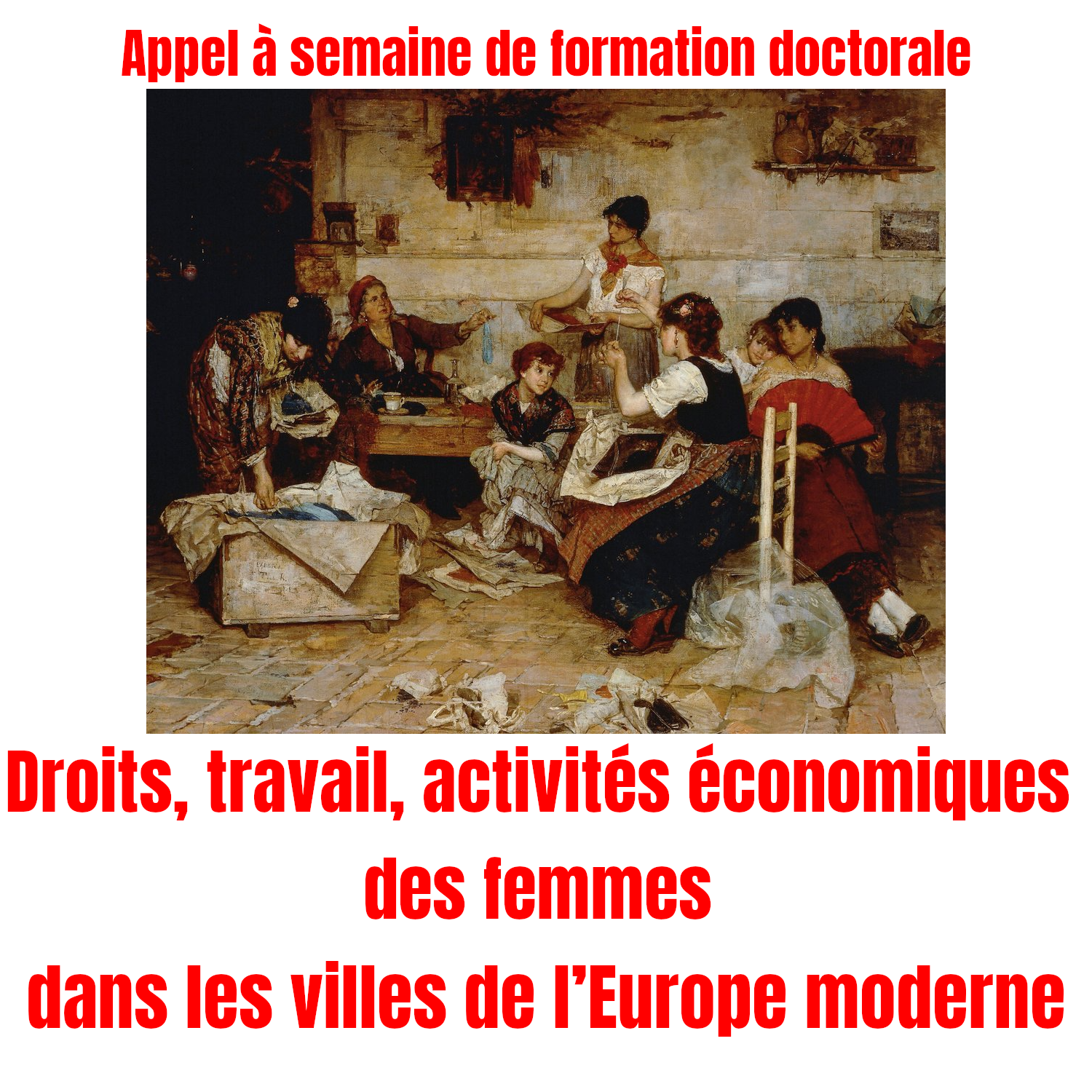
Women working pearls (1883), by Alessandro Milesi
Research into women’s and gender history always engages in dialogue with current events and contemporary issues: in the field of labour history, wage discrimination, the difficult balance between work and motherhood, and various “glass ceilings” are long-standing realities.
However, research on women’s work in pre-industrial societies has often been hampered by the silence of the archives, particularly with regard to the work of married women. This lack of documentary evidence has encouraged historians to diversify their sources, turning to “qualitative” sources and in particular judicial sources, especially in European regions where notarial sources and censuses are lacking (Ogilvie, 2003; Erickson, 2008; Ågren, 2017). The reconstruction and quantification of women’s activities in the early modern era, a period of profound change characterised by recurring crises, has progressed thanks to the intersection of quantitative and qualitative data (Macleod, Shepard, Ågren, 2023).
Beyond research on proto-industrialisation and the “industrious revolution”, which are thought to have created new job opportunities for women in rural areas, it is still worth emphasising the opportunities offered by cities. Cities were sources of support and work for women, who were a necessary resource for adapting urban economies in the context of early globalisation (Simonton, 2017 and 2023). It is important to analyse their contribution, at different stages of their life cycle, to the production of wealth and the economic development of cities, thereby re-evaluating, in relation to the historiographical developments of recent years, the opportunities offered by urban contexts in terms of assistance, access to markets and trades, but also as contexts in which clandestine or illicit income-generating activities could develop – on which guild archives and judicial sources can shed light (Bellavitis, 2018 and 2023).
In addition to highlighting the presence of women of all ages and marital statuses in the paid labour market, research has proposed a model of their presence in the guilds that contradicts the ‘decline thesis’ according to which women were excluded from the guilds in the early modern period (Howell 1986; Wiesner, 1986; Ogilvie, 2003). The image of the ‘accordion movement’ proposed by Angela Groppi in relation to Rome (Groppi, 1990) eloquently describes the process by which the inclusion or exclusion of women workers from the guilds depends on economic conditions, even though the corporate world remains fundamentally patriarchal (Ogilvie, 2019). Finally, even if they did not participate fully in the guild, women could nevertheless constitute an important workforce, bordering on undeclared work, in a grey area that is now better studied, particularly by contemporary history research (Teseohttps://www.teseopress.com/dictionnaire/).
Recent research has reintegrated women’s economic activities into the “grand narrative” of the development of capitalism and the rise of the economies of north-western Europe, placing the analysis within a broader examination of legal systems and rules governing the transfer of property, family models and women’s access to education, and by adapting the categories developed by contemporary economists to medieval and early modern Europe (Van Zanden, De Moor, Carmichael, 2019). However, this model has received well-founded criticism because it does not take into account all European research on women’s economic activities and rights, particularly in Southern Europe (Sarti, Zucca Micheletto, Lanzinger, De Rosa, 2022).
At the same time, econometric reconstructions of wages over very long periods have served as the basis for the model of the ‘Little divergence’ between northern and southern Europe (Allen, 2001), a highly questionable model based on partial series that very rarely takes women’s wages into account (Humphries, Weisdorf, 2019) and, in this case too, largely ignoring research on Southern Europe (Rota, Weisdorf, 2020).
Any research on women’s access to economic activities – work, business, credit, but also assistance – must take into account the legal dimension and examine their economic rights and how they exercised them (Bellavitis, Zucca Micheletto, 2019). The concepts of “agency” and “capabilities” remain fundamental approaches in women’s history and gender history (Simonton, Montenach, 2013).
The doctoral training week, organised as part of the ANR DÉFI programme (https://anrdefi.hypotheses.org/presentation-du-projet ), is aimed at PhD students, post-doctoral researchers and young doctors working on women’s economic activities in early modern European cities. Mornings will be devoted to lectures and afternoons to presentations and discussions of participants’ work. The working languages will be French and English. Work will begin on the morning of 7 September and end on the afternoon of 10 September. The organisers will cover accommodation (three or four nights) and meals, but not travel expenses.
The sessions will be organised around the following main themes:
1 Between quantification and micro-history of individual trajectories: multiple approaches to women’s work
2 Women’s rights and agency in European cities
3 Work within and outside urban guilds
4 Charity and work
5 Training and apprenticeships
6 Access to credit
Proposals for contributions (1500-character abstract in English or French + brief CV) should specify the corpus of sources used and the main bibliographical references.
They should be sent jointly to the organisers before 31 March 2026:
Short Bibliography
– Ågren, Maria (ed.), Making a Living, Making a Difference: Gender and Work in Early Modern European Society, New York, Oxford University Press, 2017
– Allen, Robert C., « The Great Divergence in European Wages and Prices from the Middle Ages to the First World War », Explorations in Economic History, vol. 38, n. 4, 2001, p. 411-447
– Bellavitis, Anna, Women’s Work and Rights in Early Modern Urban Europe, London, Palgrave, 2018
– Bellavitis, Anna, « Urban Markets », in Macleod, Shepard, Ågren (eds.), The Whole Economy. Work and Gender in Early Modern Europe, pp. 136-163.
– Bellavitis Anna – Zucca Micheletto, Beatrice (eds.), Gender, Law and Economic Well-Being in Europe from the Fifteenth to the Nineteenth Century. North vs South ? London-New York, Routledge, 2019
– Erickson, Amy Louise, « Married Women’s Occupations in Eighteenth-Century London », Continuity and Change, 23, 2 (2008), pp. 267-307.
– Groppi, Angela, « Un questionario da arricchire » in La donna nell’economia, secc. XIII-XVIII, Atti delle Settimane di studi dell’Istituto internazionale di Storia economica F. Datini di Prato, ed. Simonetta Cavaciocchi, Florence, Le Monnier, 1990, pp. 143-154
– Howell Marta C., Women, Production, and Patriarchy in Late Medieval Cities, Chicago, University of Chicago Press, 1986
– Humphries, Jane – Weisdorf, Jacob, “Unreal Wages? Real Income and Economic Growth in England, 1260–1850”, The Economic Journal, Volume 129, Issue 623, October 2019, p. 2867–2887
– Macleod, Catriona – Shepard, Alexandra – Ågren, Maria (eds.), The Whole Economy. Work and Gender in Early Modern Europe, Cambridge, Cambridge University Press, 2023
– Ogilvie, Sheilagh, A Bitter Living: Women, Markets, and Social Capital in Early Modern Germany, Oxford, Oxford University Press, 2003
– Sheilagh Ogilvie, The European Guilds. An Economic Analysis, Princeton and Oxford, Princeton University Press, 2019
– Rota, Mauro – Weisdorf, Jacob, « Italy and the Little Divergence in Wages and Prices: New Data, New Results », The Journal of Economic History, Vol. 80, No. 4 (December 2020), p. 931-960
– Sarti, Raffaella – Zucca Micheletto, Beatrice – Lanzinger, Margareth – De Rosa, Maria Rosaria, « About «Capital Women» by Jan Luiten Van Zanden, Tine De Moor and Sarah Carmichael », QUADERNI STORICI 171 / a. LVII, n. 2 dicembre 2022
– Simonton, Deborah – Montenach, Anne, eds., Female Agency in the Urban Economy. Gender in European Towns, 1640-1830, New York-London, Routledge, 2013
– Simonton, Deborah, ed., The Routledge History Handbook of Gender and the Urban Experience, London, New York, 2017
– Simonton, Deborah, Gender in the European Town. Ancien Regime to the Modern, London, New York, 2023
-Van Zanden, Jan Luiten-De Moor, Tine-Carmichael, Sarah, Capital Women. The European Marriage Pattern, Female Empowerment and Economic Development in Western Europe, 1300-1800, Oxford, Oxford University Press, 2019
– Wiesner, Merry E., Working Women in Renaissance Germany, New Brunswick (NJ), Rutgers University Press, 1986